
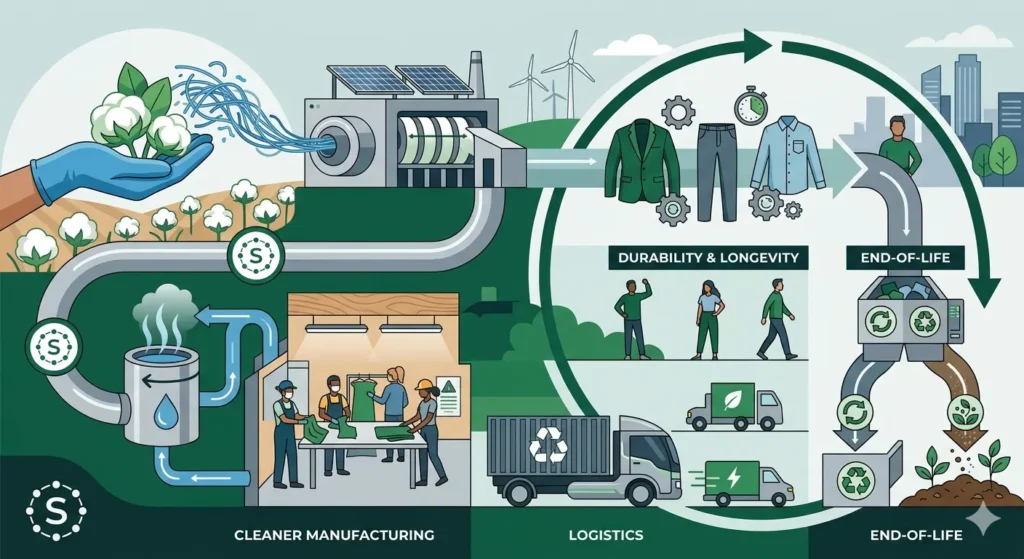
Sustainability in fashion today goes far beyond fabric choices. What defines impact is everything that happens behind the product: the sourcing, processing, manufacturing, movement, and eventual disposal of each garment.
For organizations sourcing apparel at scale, these hidden stages play a major role in overall environmental performance.
The numbers make this clear. The fashion industry contributes around 8–10% of global carbon emissions, while 70–90% of those emissions come directly from supply chains.
Textile production also consumes over 93 billion cubic meters of water annually, and more than 90 million tonnes of textile waste are generated every year.
In this line, sustainable fashion brands are making a real difference. Instead of focusing only on the finished product, they are improving each stage that leads to it, making sustainable clothing and eco-friendly apparel more efficient, responsible, and reliable.
Scope3 supports this shift by working across supply chains, helping improve material sourcing, production methods, and long-term impact.
In this blog, you will understand how sustainable fashion brands are transforming supply chains from raw materials to disposal and how this approach supports both sustainability and smarter operations.
Why Sustainable Clothing Supply Chains is Important
A garment may look simple, but the journey behind it involves multiple stages: farming, spinning, dyeing, stitching, packaging, and transport. Each of these steps consumes resources and adds to environmental impact.
Some key facts highlight the scale
- Textile dyeing contributes to nearly 20% of global industrial water pollution
- Only 1% of clothing is recycled into new garments
- The equivalent of one garbage truck of textiles is discarded every second
Sustainable fashion brands are addressing this by improving visibility and control across supply chains. When each stage is managed carefully, the overall footprint reduces without affecting quality.
Starting Right: Responsible Raw Materials
The journey of eco-friendly apparel begins with better material choices.
Conventional cotton farming uses around 16% of global insecticides and requires significant water. In contrast, sustainable clothing focuses on alternatives that reduce environmental strain.
- Organic cotton can use up to 91% less water
- Recycled polyester can reduce energy consumption by 30–50%
- Sustainable farming can improve land use efficiency by around 30%
Scope3 focuses on sourcing certified materials such as GOTS-certified cotton, helping reduce chemical usage and support better agricultural practices.
Cleaner Manufacturing, Lower Impact
Production is one of the most resource-intensive stages in the apparel lifecycle.
Sustainable fashion brands are improving this through practical, measurable changes
- Low-impact dyes reduce energy use by around 20% per batch
- Removing hazardous chemicals can cut water pollution by 60–70%
- Efficient production methods can reduce textile waste by 40–50%
- Sustainable processing can save 30–40% energy annually
Scope3 ensures that manufacturing processes are optimized to reduce waste while maintaining consistent quality in eco-friendly apparel.
Ethical Production and Safer Work Environments
Sustainability also includes how people are treated across the supply chain.
Certifications such as GOTS and OEKO-Tex help ensure
- Fair wages and ethical working conditions
- Reduced exposure to harmful chemicals
- Safer and healthier work environments
Non-toxic dyes and safer materials can reduce worker health risks by up to 70%. Scope3 aligns production with these standards, ensuring that sustainable clothing supports both environmental and social responsibility.
Smarter Logistics and Packaging
Transportation and packaging contribute substantially to the total footprint of apparel.
Sustainable fashion brands are improving logistics through
- Better planning to reduce unnecessary shipments
- Bulk movement to optimize fuel usage
- Use of recyclable or minimal packaging
Scope3 supports eco-friendly apparel delivery through packaging solutions that reduce waste and are easier to recycle, helping lower overall environmental impact.
Designing Sustainable Clothing for Longer Use
One of the simplest ways to reduce environmental impact is to extend the life of garments.
On average, clothing today is worn 30–40% fewer times than it was 15 years ago, leading to faster disposal and higher waste.
Sustainable fashion brands focus on
- Durable fabrics
- Better construction quality
- Designs that remain usable over time
We ensure that sustainable clothing is built for longevity, helping reduce replacement frequency and overall waste.
End-of-Life: Reducing Waste and Supporting Circularity
What happens after use is just as important as production.
- Around 87% of textile waste ends up in landfills or incineration
- Only a small portion is reused or recycled effectively
Sustainable fashion brands are addressing this through
- Biodegradable materials
- Reduced use of synthetic fibers
- Designing garments that are easier to recycle
We integrate these practices into eco-friendly apparel development, helping reduce landfill waste and long-term environmental damage.
Why This Approach Works
Improving supply chains is not only about sustainability; it also improves efficiency and consistency.
Cleaner systems often lead to
- Better resource management
- Lower long-term costs
- Stronger brand credibility
- Alignment with environmental expectations
Scope3 supports organizations in adopting sustainable clothing solutions that balance performance, responsibility, and scalability.
Conclusion
From raw materials to disposal, every stage of the supply chain shapes the true impact of fashion.
Sustainable fashion brands are improving these systems through better sourcing, cleaner production, ethical practices, and reduced waste.
Scope3 continues to support this shift by helping organizations adopt sustainable clothing and eco-friendly apparel that align with long-term sustainability goals.
Small improvements across each stage can create measurable impact, and that is where real change begins.
Looking to shift towards eco-friendly apparel with a more responsible supply chain? Get in touch with Scope3 today or call to explore sustainable clothing solutions designed for long-term value.
FAQs
What is sustainable fashion?
Sustainable fashion focuses on creating clothing in ways that reduce environmental impact and support ethical practices across the supply chain.
Why are supply chains important in sustainable clothing?
Most environmental impact comes from sourcing, production, and transport, so improving supply chains helps reduce emissions, waste, and resource use.
What materials are used in eco-friendly apparel?
Eco-friendly apparel often uses organic cotton, recycled polyester, and biodegradable fabrics that are safer for the environment.
How does sustainable clothing reduce waste?
It focuses on durable designs, low-waste production methods, and materials that can be reused, recycled, or naturally broken down.
Is sustainable fashion more expensive?
While initial costs may be higher, sustainable clothing often lasts longer, making it more cost-effective over time.