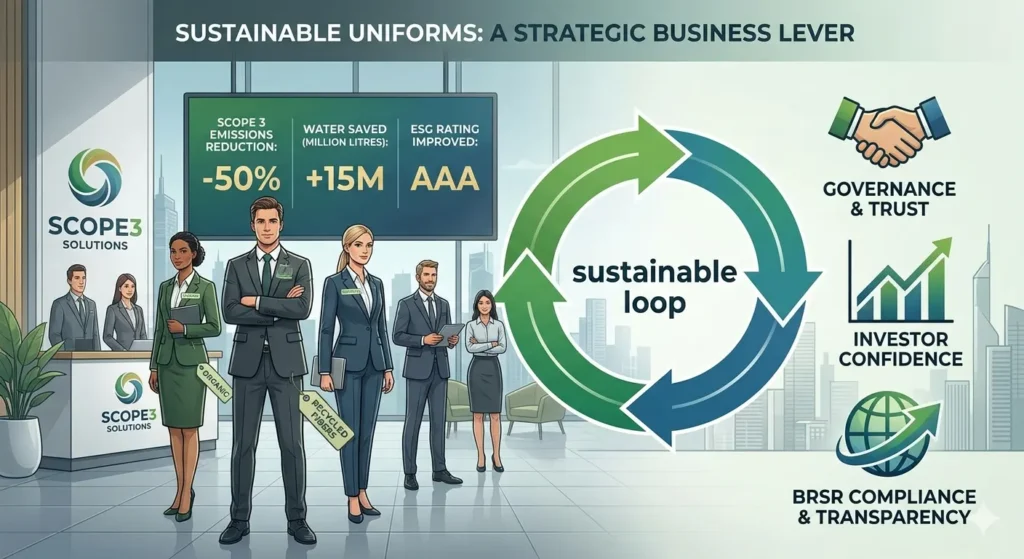
In the present regulatory and investor-driven environment, Environmental, Social, and Governance (ESG) performance is directly linked to capital access, stakeholder confidence, and brand valuation.
Procurement categories that were once treated as operational necessities are now evaluated through the lens of carbon accounting, supply chain governance, and sustainability disclosure.
Among these categories, corporate uniform apparel holds strategic relevance. For enterprises managing distributed workforces, retail networks, manufacturing units, or service teams, uniform procurement represents recurring material consumption, water usage, carbon emissions, and waste generation.
Under the Greenhouse Gas (GHG) Protocol, these fall within Scope 3 emissions, indirect emissions generated across the value chain.
Scope3 partners with large corporates to convert uniform procurement into a tangible sustainability lever, aligning apparel sourcing with enterprise-wide ESG objectives.
As sustainability frameworks such as Business Responsibility and Sustainability Reporting (BRSR) mature in India, businesses are recognising the strategic value of working with sustainable fashion brands to strengthen transparency and reduce environmental exposure.
In this blog, we explore why partnering with sustainable fashion brands is a strategic decision for enterprises seeking responsible and measurable corporate uniform solutions.
The Scale of Environmental Impact in Apparel Procurement
The fashion and textile sector accounts for approximately 8–10% of global carbon emissions and consumes around 93 billion cubic metres of water annually, according to the United Nations Environment Programme (UNEP).
For corporates procuring bulk volumes of corporate wear uniforms, this impact becomes material.
Conventional cotton production can require nearly 2,700 litres of water per T-shirt. When organisations source thousands of units of uniform corporate wear, the cumulative water footprint escalates rapidly.
Additionally, textile processing often involves chemical treatments that contribute to industrial water pollution.
Scope 3 emissions frequently account for over 70% of total corporate emissions in procurement-intensive industries.
Apparel sourcing, therefore, directly influences reported ESG performance. Treating corporate uniform apparel strategically allows companies to address measurable environmental metrics rather than relying on broad estimations.
Quantifiable Sustainability Gains through Responsible Sourcing
Partnering with sustainable fashion brands introduces measurable environmental efficiencies into uniform procurement.
Through responsible fibre selection and production methods
- Organic cotton production can reduce water usage by up to 91% compared to conventional farming.
- Switching to organic cotton can save approximately 1,350 litres of water per T-shirt, assuming a 50% reduction from conventional processes.
- Organic cotton and Tencel fabrics may reduce carbon dioxide (CO₂) emissions by approximately 1.2–1.6 kg per kilogram of fabric.
- Responsible sourcing can lower overall garment carbon footprint by 50–60% per garment.
- Biodegradable fabrics can reduce textile waste by 40–50% annually.
- Eliminating hazardous chemicals can reduce water pollution by approximately 60–70%.
- Global Organic Textile Standard (GOTS) certified organic cotton eliminates nearly 100% of synthetic pesticides and insecticides.
When applied across enterprise-scale procurement of corporate wear uniforms, these reductions translate into substantial aggregate impact, measurable in sustainability reports and annual disclosures.
Scope3’s sustainable clothing solutions deliver these data-backed reductions at the material and production level. These measurable outcomes enable corporates to incorporate verified supplier metrics into ESG dashboards instead of relying on industry averages.
Why Sustainable Fashion Brands Strengthen Corporate Governance
Sustainability in uniform sourcing extends beyond environmental metrics. It directly supports governance and compliance objectives.
1. Traceability and Documentation
Partnering with sustainable fashion brands ensures traceability across raw materials, manufacturing processes, chemical standards, and animal welfare practices.
This strengthens audit preparedness under Business Responsibility and Sustainability Reporting (BRSR) while aligning with global disclosure frameworks including the Global Reporting Initiative (GRI) and the Task Force on Climate-related Financial Disclosures (TCFD).
Recognised certifications such as Global Organic Textile Standard (GOTS) and People for the Ethical Treatment of Animals (PETA) further reinforce reporting credibility.
2. Ethical Labour Compliance
Third-party certifications such as Fair Trade validate labour standards and supply chain ethics, supporting the “Social” pillar of ESG.
3. Risk Mitigation
Transparent procurement of corporate uniform apparel reduces reputational and regulatory exposure, particularly as investor scrutiny around supply chains increases.
Financial and Strategic Business Case
Sustainability and financial prudence increasingly intersect.
Optimised Cost Performance Over Time
Durable, high-quality uniform corporate wear reduces replacement frequency. Fewer reorder cycles decrease logistics costs, production emissions, and administrative overhead.
Improved ESG Ratings
Institutional investors integrate ESG scores into portfolio allocation decisions. Transparent sourcing of corporate wear uniforms contributes positively to sustainability performance indicators.
Enhanced Employer Branding
Employees increasingly evaluate corporate values through visible actions. Sustainable corporate uniform apparel communicates organisational commitment to responsible operations.
Stronger Stakeholder Trust
Companies that embed sustainability into procurement demonstrate long-term resilience and operational maturity.
Scope3 works with procurement and sustainability teams to align material selection, lifecycle assessment, and reporting integration, ensuring that uniform sourcing contributes directly to enterprise sustainability metrics.
Engineering Longevity for Measurable Impact
One of the most overlooked sustainability levers in apparel procurement is durability.
Extending garment lifespan reduces the frequency of manufacturing cycles, thereby lowering cumulative carbon emissions and water usage.
By engineering long-lasting corporate wear uniforms, companies reduce both environmental impact and long-term procurement volumes.
This approach delivers measurable Scope 3 reductions and aligns with corporate carbon targets.
Sustainability becomes most effective when consumption frequency declines, not just when materials improve.
Integrating Sustainable Uniform Strategy into Corporate Procurement
To optimise the sustainability impact of uniform corporate wear, enterprises should
- Include sustainability performance indicators in supplier contracts
- Prioritise certified materials such as Global Organic Textile Standard (GOTS)-certified organic cotton
- Integrate supplier emissions data into ESG reporting systems
- Establish lifecycle benchmarks for corporate uniform apparel
- Align procurement policies with enterprise sustainability roadmaps
Collaborating with experienced sustainable fashion brands simplifies this transition by providing structured data, certification documentation, and traceable supply chain insights.
Strategic Outlook
Investor expectations, regulatory frameworks, and stakeholder scrutiny continue to elevate supply chain accountability. Uniform sourcing intersects directly with these evolving standards.
By embedding measurable reductions in water use, carbon emissions, textile waste, and chemical pollution into procurement decisions, enterprises convert corporate wear uniforms into strategic ESG assets.
Scope3 enables organisations to move beyond transactional sourcing and adopt structured, data-driven sustainability integration across corporate uniform apparel categories.
Uniform procurement reflects corporate priorities. When sustainability becomes embedded at this operational level, reporting strength, brand credibility, and long-term resilience improve simultaneously.
Partner with Scope3
If your organisation is ready to integrate sustainability into corporate uniform apparel procurement and convert corporate wear uniforms into measurable ESG performance drivers, now is the time to act.
Connect with Scope3 to build a structured, data-backed uniform strategy aligned with your enterprise sustainability goals.
FAQs
How do corporate uniforms impact Scope 3 emissions?
Corporate uniforms fall under “purchased goods and services” in the Greenhouse Gas (GHG) Protocol. This means emissions generated during material sourcing, production, and transportation are counted as Scope 3 emissions in ESG reporting.
Why should companies choose sustainable fashion brands for uniforms?
Sustainable fashion brands provide traceable supply chains, certified materials, and measurable environmental data. This supports stronger ESG disclosures, risk mitigation, and improved investor confidence.
How much water can be saved through organic cotton uniforms?
Organic cotton production can reduce water usage by up to 91% compared to conventional methods. A single organic cotton T-shirt can save approximately 1,350 litres of water.
Do sustainable corporate wear uniforms reduce carbon emissions?
Yes. Organic cotton and Tencel fabrics may reduce CO₂ emissions by approximately 1.2–1.6 kg per kilogram of fabric, and responsible production can lower garment carbon footprints by up to 50–60%.
What certifications should corporates look for in uniform suppliers?
Companies should prioritise certifications such as Global Organic Textile Standard (GOTS), Fair Trade, and compliance frameworks aligned with ESG and Business Responsibility and Sustainability Reporting (BRSR) standards.