
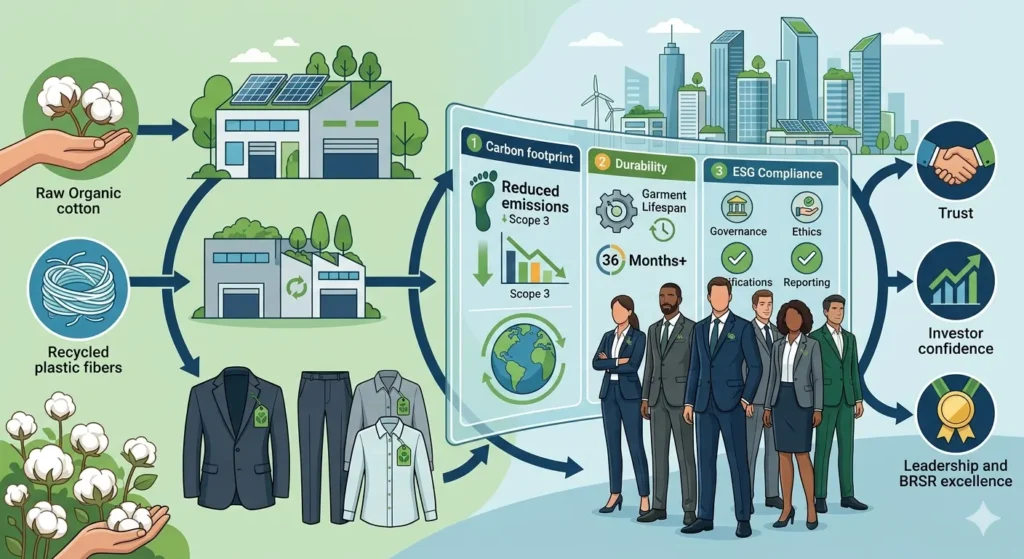
Environmental, Social, and Governance (ESG) performance is now a defining metric for large corporates in India.
With Business Responsibility and Sustainability Reporting (BRSR) now mandatory for India’s top 1,000 listed companies and Scope 3 emissions under sharp investor scrutiny, ESG accountability extends far beyond direct operations.
Sustainability must now be embedded across the entire value chain, including procurement decisions that were once considered routine.
Uniforms and workforce apparel further sit within ‘purchased goods and services’ under the Greenhouse Gas (GHG) Protocol.
For large organisations managing thousands of employees across offices, plants, logistics hubs, and field operations, apparel becomes a measurable contributor to Scope 3 emissions.
Scope3 works with large corporates to transform uniform procurement into a structured ESG lever.
In this blog, we outline how sustainable fashion brands enable stronger ESG disclosures, reduce indirect emissions, and convert sustainable clothing into measurable sustainability performance.
The Indian Context: Why Apparel Procurement is Important
India is one of the largest textile producers globally, contributing nearly 2% to national GDP and employing over 45 million people.
At the same time, the sector contributes meaningfully to greenhouse gas emissions, industrial water usage, and large-scale textile waste.
For large corporates, uniform procurement operates at scale. A workforce of 5,000–50,000 employees can require multiple uniform cycles annually across different departments.
Each procurement cycle carries upstream emissions from raw material extraction, textile processing, stitching, packaging, and transportation.
Scope 3 emissions often represent 70–90% of a corporation’s total carbon footprint. As more Indian companies voluntarily disclose Scope 3 data beyond regulatory minimums, supply chain transparency becomes a competitive differentiator.
As a sustainable fashion brand, we enable corporates to transform apparel procurement from an overlooked operational cost into a structured, measurable ESG strategy aligned with Scope 3 accountability.
Sustainable Clothing as a Strategic Scope 3 Intervention
When we integrate sustainable clothing into large-scale corporate procurement, we address emissions at multiple levels.
Responsible Material Selection
Certified organic cotton and recycled fibres reduce carbon intensity, chemical usage, and water consumption compared to conventional alternatives.
When integrated into large-scale uniform procurement, these material decisions directly influence Scope 3 emissions reporting under the Greenhouse Gas (GHG) Protocol.
For enterprises managing high garment volumes, responsible fibre sourcing can deliver measurable impact
- Up to 91% lower water consumption through organic cotton cultivation compared to conventional farming practices.
- Approximately 1.2–1.6 kilograms lower carbon dioxide (CO₂) emissions per kilogram of fabric, depending on fibre and processing methods.
- An estimated 50–60% lower carbon footprint per garment through sustainable material selection and cleaner production systems.
When scaled across distributed workforces and recurring procurement cycles, these per-garment efficiencies translate into material Scope 3 reductions.
Through structured material sourcing and impact tracking, Scope3 helps enterprises strengthen Environmental, Social, and Governance (ESG) disclosures with verifiable supplier data instead of industry assumptions.
Verified Production Standards
Transparent supply chains backed by ESG compliance, BRSR alignment, PETA-Approved Vegan, and Fair Trade certifications provide documented governance support. This reduces reputational risk while strengthening audit readiness.
Lifecycle Emissions Awareness
By mapping sourcing, manufacturing, logistics, and durability metrics, corporates gain clearer visibility into apparel-related Scope 3 categories.
Instead of reporting estimated emissions based on industry averages, organisations can incorporate supplier-backed data into sustainability dashboards and annual disclosures.
Durability as a Measurable ESG Multiplier
Large corporates often overlook the emissions impact of uniform replacement cycles. If garments are replaced annually due to wear, cumulative manufacturing and logistics emissions compound rapidly.
Durable sustainable clothing extends product life to 24–36 months or longer, depending on operational conditions. This reduces
- Total production volume
- Transport frequency
- Procurement spend volatility
- Textile waste generation
When applied across thousands of employees, lifecycle extension becomes a quantifiable carbon reduction strategy.
Scope3 engineers durability into fabric selection and design standards because long-term ESG performance depends on reducing consumption frequency, not merely switching materials.
Governance, Risk, and Investor Confidence
Large corporates operate under heightened scrutiny from institutional investors, rating agencies, and ESG benchmarking platforms. Procurement transparency directly influences sustainability ratings and capital perception.
Sustainable fashion brands strengthen governance in three key ways
- Traceability – Clear documentation across sourcing and production stages.
- Certification – Third-party certifications aligned with ESG and BRSR frameworks, including Fair Trade, provide documented assurance across labour, compliance, and supply chain integrity.
- Audit Support – Structured data that simplifies reporting and assurance processes.
Uniform procurement that aligns with sustainable clothing standards demonstrates proactive value chain management, a critical indicator of ESG maturity.
For listed companies and multinational corporations operating in India, this alignment reinforces credibility in sustainability reports, integrated annual reports, and investor communications.
Brand Alignment and Corporate Identity
For large corporates, uniforms are highly visible symbols of brand identity. They represent organisational culture across offices, plants, and client-facing environments.
When those uniforms are sourced from sustainable fashion brands, they communicate consistency between corporate values and operational decisions.
Employees increasingly expect employers to demonstrate environmental responsibility beyond marketing statements. Investors expect measurable action.
Sustainable clothing becomes a tangible expression of climate commitment and ethical governance, worn daily by the workforce.
Moving from Compliance to Leadership
The regulatory sphere in India is tightening. Scope 3 reporting sophistication is increasing. ESG-linked financing instruments are expanding. In this environment, sustainability performance influences competitive positioning.
Uniform procurement offers a practical and scalable intervention point.
By embedding sustainability into apparel sourcing, large corporates can
- Reduce Scope 3 emissions exposure
- Strengthen BRSR disclosures
- Improve ESG ratings
- Lower long-term lifecycle impact
- Enhance stakeholder trust
Scope3 partners with large corporates to convert everyday workforce apparel into measurable sustainability infrastructure.
Through certified materials, transparent production, and durability-focused design, we ensure that sustainable clothing supports not only operational efficiency but ESG performance at scale.
For organisations committed to climate accountability and governance excellence, apparel must be treated as a core component of ESG strategy, not a secondary spend category.
Sustainable fashion brands play a critical role in reforming workforce apparel into measurable value chain performance that strengthens disclosures, reduces Scope 3 exposure, and reinforces corporate credibility.
FAQs
How do corporate uniforms impact ESG reporting?
Corporate uniforms fall under ‘purchased goods and services’ in the Greenhouse Gas (GHG) Protocol, which makes them part of Scope 3 emissions. Sustainable sourcing helps organisations reduce indirect emissions and strengthen ESG disclosures.
What are Scope 3 emissions in apparel procurement?
Scope 3 emissions in apparel include indirect emissions from raw material extraction, textile manufacturing, logistics, product usage, and disposal. These often represent a significant portion of a company’s overall carbon footprint.
Why should large corporates choose sustainable clothing suppliers?
Sustainable clothing suppliers provide traceability, certifications, and lifecycle transparency. This supports ESG compliance, reduces reputational risk, and improves reporting accuracy.
How does durable clothing support sustainability goals?
Durable garments reduce replacement frequency, which lowers manufacturing emissions, transport impact, and textile waste. This contributes directly to Scope 3 reduction strategies.
What certifications should corporates look for in sustainable apparel?
Corporates should prioritise certifications aligned with ESG frameworks, such as Fair Trade, BRSR-aligned compliance, and recognised environmental or ethical production standards.